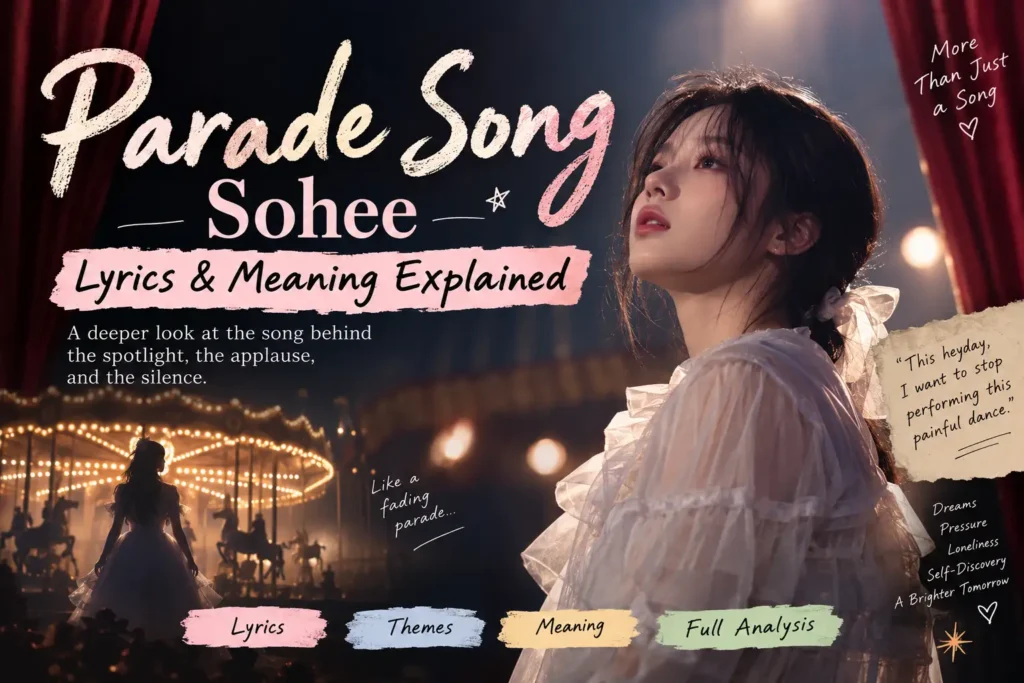
| 🎵 Song Information | |
|---|---|
| Song Name | PARADE (生) |
| Singer | Song Sohee (송소희) |
| Lyricist | Song Sohee |
| Release Date | June 19, 2026 |
| Songwriter | Song Sohee |
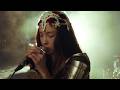
Parade Song Sohee Lyrics & Meaning Explained
People searching for parade song sohee lyrics are usually looking for more than the words to Song Sohee’s latest song. They also want to understand the Korean lyrics, the English meaning, the emotional story behind the repeated “parade” image, and the reason the song feels both beautiful and deeply lonely.
“PARADE (生)” by Song Sohee (송소희) is a Korean-language song released in 2026. The official artist channel identifies the track as “PARADE (生),” while Korean music services list Song Sohee as the artist and credit her with the lyrics and composition. The track is approximately four minutes long, and the official music video was released in June 2026.
The song presents life as something resembling a stage performance. A curtain rises. Music begins. Bright lights surround the performer. People push the singer into the center and expect her to perform. Then, just as quickly, everyone disappears. What remains is the performer, the next curtain call, and the painful feeling that something meaningful is constantly moving farther away.
That idea gives the song its emotional force. The “parade” is not presented simply as a cheerful celebration. It becomes a metaphor for time, expectations, performance, loneliness, and a life that keeps moving even when the person inside it is exhausted.
This guide breaks down the Parade Song Sohee lyrics by looking at the song’s story, English meaning, important Korean phrases, symbolism, emotional themes, musical identity, and the deeper interpretation suggested by the lyrics.
parade song sohee lyrics
| Original Lyrics | English Translation | Hindi Translation |
|---|---|---|
| Magi ollatdeon sungando | Even in the very moment the curtain rose, | जिस पल पर्दा उठा, उसी क्षण भी, |
| Iyureul mollanne | I didn’t really understand why I was there. | मुझे सच में समझ नहीं आया कि मैं वहाँ क्यों थी। |
| Eumagi deullyeoyo, rara ra rara rara | I can hear the music now, rara ra rara rara. | अब मुझे संगीत सुनाई दे रहा है, रारा रा रारा रारा। |
| Nal gidarina bwayo | It seems to be waiting just for me. | लगता है, जैसे वह सिर्फ मेरा ही इंतज़ार कर रहा हो। |
| Useuramyeo deungeul tteomilmyeon | Then, with smiles, they gently push me forward. | फिर मुस्कुराते हुए वे मुझे धीरे-धीरे आगे बढ़ाते हैं। |
| Hayan jomyeonge powidwaeyo, oh | I’m enveloped by those bright white lights, oh. | मैं उन तेज़ सफेद रोशनियों से घिर जाती हूँ, ओह। |
| Eoseo, ramyeo nal jungange sewonoko | They tell me to ‘Come on,’ placing me right in the center. | वे कहते हैं, ‘चलो,’ और मुझे ठीक बीचों-बीच खड़ा कर देते हैं। |
| Da tteonaganeyo | But then everyone just leaves. | लेकिन फिर सब लोग चले जाते हैं। |
| Para-a-a-a-adecheoreom heulleoganeyo | It all just flows away like a fading parade. | सब कुछ एक फीकी पड़ती परेड की तरह बहता हुआ दूर चला जाता है। |
| Eoeoeoeodie innayo | And where are they all now? | और अब वे सब कहाँ हैं? |
| Heyday-ay-ay-ay-ay seulpeun chumeun geuman chullae | This heyday, I want to stop performing this painful dance. | इस सुनहरे दौर में, मैं यह दर्दभरा नृत्य करना बंद करना चाहती हूँ। |
| Janinhan igoseseo | In this cruel and unforgiving place. | इस निर्दयी और बेरहम जगह में। |
| (Ooh-ooh, ooh-ooh) | Ooh-ooh, ooh-ooh. | ऊह-ऊह, ऊह-ऊह। |
| (Ooh-ooh) | Ooh-ooh. | ऊह-ऊह। |
| (Ooh-ooh, ooh-ooh) | Ooh-ooh, ooh-ooh. | ऊह-ऊह, ऊह-ऊह। |
| No, no, no way | No, no, no way. | नहीं, नहीं, बिल्कुल नहीं। |
| Byeoldareul geon eopjyo daeumbeondo | There won’t be anything special next time either. | अगली बार भी कुछ खास नहीं होगा। |
| Geujeo daeum mageul gidarineun | Just waiting for the next curtain call. | बस अगले पर्दा उठने के पल का इंतज़ार करते हुए। |
| Jeo sarami boyeo | I can see that familiar person now. | अब मुझे वह जाना-पहचाना व्यक्ति दिखाई देता है। |
| Gateun eolgul gateun moksorie bochaeji | I’m hurried on by the same faces and the same voices. | वही चेहरे और वही आवाज़ें मुझे जल्दी-जल्दी आगे बढ़ाती रहती हैं। |
| Jiteun haengun han julman dallago | I just want one line of true fortune, I think. | मुझे लगता है, मैं बस सच्चे सौभाग्य की एक पंक्ति चाहती हूँ। |
| Irijeori gidaehae bwado | Even if I try to expect something from it all. | चाहे मैं इन सब चीज़ों से कुछ उम्मीद करने की कोशिश करूँ। |
| Jakkuman meoreojineun geot gata, ah | It just feels like it keeps slipping away, ah. | फिर भी लगता है कि सब कुछ लगातार दूर खिसकता जा रहा है, आह। |
| A, a | Ah, ah. | आह, आह। |
| Da tteonaganeyo | Everyone just leaves in the end. | आखिर में सब लोग चले ही जाते हैं। |
| Para-a-a-a-adecheoreom heulleoganeyo | It all just flows away like a fading parade. | सब कुछ एक फीकी पड़ती परेड की तरह बहता हुआ दूर चला जाता है। |
| Eoeoeoeodie innayo | And where are they all now? | और अब वे सब कहाँ हैं? |
| Heyday-ay-ay-ay-ay seulpeun chumeun geuman chullae | This heyday, I want to stop performing this painful dance. | इस सुनहरे दौर में, मैं यह दर्दभरा नृत्य करना बंद करना चाहती हूँ। |
| Janinhan igoseseo | In this cruel and unforgiving place. | इस निर्दयी और बेरहम जगह में। |
| Para-a-a-a-adecheoreom heulleoganeyo (Ooh-ooh) | It all just flows away like a fading parade, ooh-ooh. | सब कुछ एक फीकी पड़ती परेड की तरह बहता हुआ दूर चला जाता है, ऊह-ऊह। |
| Eoeoeoeodie innayo (Ooh-ooh) | And where are they all now, ooh-ooh? | और अब वे सब कहाँ हैं, ऊह-ऊह? |
| Heyday-ay-ay-ay-ay seulpeun chumeun geuman chullae | This heyday, I want to stop performing this painful dance. | इस सुनहरे दौर में, मैं यह दर्दभरा नृत्य करना बंद करना चाहती हूँ। |
| Janinhan igoseseo (Ooh-ooh) | In this cruel and unforgiving place, ooh-ooh. | इस निर्दयी और बेरहम जगह में, ऊह-ऊह। |
| Para-a-a-a-adecheoreom heulleoganeyo | It all just flows away like a fading parade. | सब कुछ एक फीकी पड़ती परेड की तरह बहता हुआ दूर चला जाता है। |
| Eoeoeoeodie innayo (Ooh-ooh, ooh oh) | And where are they all now, ooh-ooh, ooh oh? | और अब वे सब कहाँ हैं, ऊह-ऊह, ऊह ओह? |
| Heyday-ay-ay-ay-ay seulpeun chumeun geuman chullae | This heyday, I want to stop performing this painful dance. | इस सुनहरे दौर में, मैं यह दर्दभरा नृत्य करना बंद करना चाहती हूँ। |
| Janinhan igoseseo | In this cruel and unforgiving place. | इस निर्दयी और बेरहम जगह में। |
| (Ooh-ooh, ooh-ooh) | Ooh-ooh, ooh-ooh. | ऊह-ऊह, ऊह-ऊह। |
| (Ooh-ooh) | Ooh-ooh. | ऊह-ऊह। |
| No, no, no way | No, no, no way. | नहीं, नहीं, बिल्कुल नहीं। |
What Is “PARADE (生)” by Song Sohee?
“PARADE (生)” is a 2026 release by Korean singer-songwriter Song Sohee. The official artist release identifies the song as “PARADE (生),” and the official live demonstration version states that Song Sohee wrote and composed the song, with arrangement by Choi Himchan.
Korean music service Genie lists the song as a 3:56 track and credits Song Sohee as lyricist and composer, with arrangement credits involving Song Sohee and 구름. Bugs similarly lists the June 19, 2026 release and identifies Song Sohee as the vocalist and songwriter.
The song’s official concept is especially important. The album information on Bugs describes life as something like an endless parade in which people continue living while looking forward to the “next act” on their individual stages.
That description provides a useful key to the lyrics: this is a song about life as performance.
Parade Song Sohee Lyrics: What Is the Main Meaning?
The central meaning of the song can be understood as a struggle between performing for others and searching for one’s own identity.
The narrator begins almost passively. The curtain opens, but she does not understand why she is there. Music starts playing, and she senses that something is waiting for her.
Then the pressure begins.
She is told to smile. She is pushed forward. White stage lights surround her. She is placed in the center. Everyone appears to expect something from her.
And then they leave.
This is one of the song’s most important emotional ideas. The people who push someone toward the spotlight are not necessarily the people who stay with them when the performance becomes difficult.
The song therefore explores the loneliness that can exist behind public attention.
A person may appear to be at the center of everything while privately feeling abandoned.
That contrast between visibility and isolation is one of the strongest ideas in “PARADE (生).”
The English Meaning of Parade Song Sohee Lyrics
The supplied English translation captures the broad narrative of the Korean original, but several ideas are especially important to understand.
| Korean lyric idea | English meaning | Emotional significance |
|---|---|---|
| The curtain rises | The performance begins | Entering a role without fully understanding it |
| Music begins | The signal to perform | A life controlled by expectations |
| White lights surround the narrator | She is placed under intense attention | Exposure and pressure |
| Everyone leaves | The performer is suddenly alone | Abandonment and emotional emptiness |
| The parade flows away | Life and moments continue disappearing | The passage of time |
| Where is my heyday? | Where did my best period go? | Longing for lost happiness or vitality |
| I want to stop the sad dance | The narrator wants to stop pretending | Emotional exhaustion |
The English meaning is therefore less about a literal parade and more about the experience of being carried forward by circumstances that never seem to stop.
The narrator is performing because the world expects a performance. She is moving because the parade keeps moving.
But emotionally, she wants to stop.
What Does “Parade” Symbolize in the Song?
The word parade is the key metaphor.
A parade is usually associated with celebration, movement, music, color and crowds. It is something people watch as it passes. Once a section has gone by, it cannot simply return in the same form.
That makes the image particularly effective for this song.
Life also keeps moving.
Moments arrive, appear important for a short time, and then disappear. People enter our lives and leave. Opportunities appear and vanish. Periods of happiness can feel permanent while they are happening, only to become memories later.
When the narrator compares everything to a fading parade, the image communicates the feeling of watching life move past without being able to hold onto it.
The parade is beautiful, but it is temporary.
That combination of beauty and impermanence gives the song much of its sadness.
What Does “Heyday” Mean in Parade Song Sohee Lyrics?
One of the most striking words in the chorus is “Heyday.”
In English, heyday generally refers to a period when someone or something is at its greatest level of success, vitality, popularity or happiness.
Within the context of Song Sohee’s song, asking where the “heyday” is can be interpreted as asking:
- Where did the happiest time go?
- Where did my confidence go?
- Where did the version of myself that felt alive disappear?
- Why does the best moment always seem to be somewhere behind me?
The word therefore adds a strong sense of nostalgia to the song.
The narrator is not simply unhappy with the present. She appears to be searching for something she believes she once had—or perhaps something she imagined she would eventually have.
That ambiguity makes the word powerful.
The Stage as a Metaphor for Real Life
The lyrics repeatedly use performance imagery: curtains, music, lights, a center position, dancing and waiting for the next act.
Those images can be understood literally as a theatrical performance, but the broader metaphor is much more universal.
Most people perform different versions of themselves depending on where they are.
At work, they may act confident.
With family, they may behave differently.
On social media, they may show only selected parts of their lives.
In public, they may smile even when they are exhausted.
That is why the line of thought behind the song can resonate far beyond professional performers.
The “stage” can be everyday life.
The “audience” can be society.
The “lights” can represent attention.
The “dance” can symbolize the repeated behavior required to satisfy other people’s expectations.
Under this interpretation, “PARADE (生)” becomes a song about the pressure to continue playing a role even when that role no longer feels authentic.
Why the White Lights Matter
The reference to bright white stage lights is another important image.
Light normally suggests beauty, visibility or success. In this song, however, the light is almost overwhelming.
The narrator is surrounded by it.
That changes the meaning of the spotlight.
Instead of simply representing fame, it can represent exposure.
When everyone is looking at you, there is nowhere to hide.
The brighter the light becomes, the more visible every movement is.
This is why the song can be interpreted as a commentary on performance culture, public expectations and the emotional pressure associated with being watched.
“Everyone Leaves”: The Loneliness Behind Attention
One of the most repeated ideas in the song is that the people surrounding the narrator eventually leave.
That repetition is not accidental.
The emotional story is built around a cycle:
- The curtain opens.
- The performer is pushed toward the center.
- The lights come on.
- The performer is expected to smile.
- The performance happens.
- The crowd disappears.
- The narrator waits for another act.
The cycle continues.
This creates an image of someone whose life is governed by repeated performances but who receives very little emotional security in return.
It can therefore be read as a song about the difference between being needed and being cared for.
A crowd may need a performance.
That does not mean the crowd will remain after the performance.
The Meaning of “The Next Curtain”
The next curtain represents repetition.
After one performance ends, another begins.
After one difficult day comes another day.
After one expectation is satisfied, another expectation appears.
The phrase can therefore be read as a metaphor for a life where there is always something else to prepare for.
This is a very modern feeling.
Many people experience an endless sequence of deadlines, responsibilities, social expectations and personal goals. Finishing one task rarely means complete rest; instead, another task waits immediately afterward.
The song’s theatrical metaphor makes that psychological pressure easy to visualize.
The curtain never seems to stay closed for long.
Why the Song Repeats the Chorus
The repeated chorus strengthens the idea that the narrator is trapped in a cycle.
The same emotional questions return again and again.
Where is the better time?
Why does everything keep disappearing?
Why must the sad performance continue?
Repetition in this context does not simply make the song catchy. It mirrors the emotional experience described by the narrator.
She is repeating the same performance and experiencing the same disappointment.
That gives the recurring chorus a feeling of inevitability.
Parade Song Sohee Lyrics and the Idea of Emotional Exhaustion
One of the clearest feelings in the song is exhaustion.
The narrator does not merely say that the environment is unpleasant. She wants to stop dancing.
That distinction matters.
Dancing is an active behavior. It implies that the narrator is participating even though she does not want to continue.
This can symbolize the exhausting experience of maintaining a role for too long.
Someone can appear productive, successful, cheerful or confident while internally wanting everything to stop for a moment.
By describing that experience through dance, Song Sohee makes the emotion physical.
She is not simply emotionally tired.
She is tired of performing.
The Korean Word “잔인한” and the Song’s Darker Tone
The Korean expression “잔인한 이곳에서” describes being in a cruel or unforgiving place.
This phrase changes the emotional interpretation of everything around it.
The stage is not simply glamorous.
The music is not simply beautiful.
The parade is not simply celebratory.
The setting itself has become emotionally hostile.
That contrast is one of the song’s strongest characteristics. Something that looks beautiful from the outside can still feel painful from within.
It is an effective metaphor for environments where appearances matter more than emotional wellbeing.
Song Sohee’s Writing and the Self-Reflection in the Song
The official live version credits Song Sohee with both lyrics and composition. The album credits published by Bugs likewise name Song Sohee as lyricist and composer, with additional arrangement work by 구름 and Song Sohee.
That authorship is important because the song feels highly personal.
Rather than presenting a complicated fictional plot, the lyrics use simple theatrical images to explore a difficult internal state.
The emotional vocabulary is direct: performance, waiting, disappearance, hope, distance and exhaustion.
That simplicity allows listeners to project their own experiences onto the song.
PARADE (生): What Does “生” Add to the Title?
The Chinese character “生” can carry meanings associated with life, birth, existence or being alive, depending on context.
That makes the title especially interesting when placed next to “PARADE.”
A parade is something that passes.
“生” evokes life.
Together, the title can suggest something like life as a moving procession: one moment arriving after another, each appearing briefly before disappearing behind us.
This reading also fits the album description published by Bugs, which presents life itself through the image of an endless parade and emphasizes the expectation of the next act.
Step-by-Step Guide to Understanding the Song
Step 1: Imagine the Theater
Start by imagining a performer standing backstage as the curtain rises. She is expected to know what to do, even though she is not sure why she is there.
Step 2: Follow the Movement
Notice how the narrator is physically pushed toward the center. Movement is imposed on her rather than chosen freely.
Step 3: Focus on the Lights
The lights make her visible but do not make her emotionally safe.
Step 4: Notice the Disappearance
After the performance begins, everyone leaves. This transforms a public performance into a private experience of loneliness.
Step 5: Interpret the Parade
Think about the parade as time itself. Everything moves forward, whether the narrator is ready or not.
Step 6: Understand “Heyday”
The narrator asks where the best time has gone, which introduces nostalgia and the fear of losing one’s brightest period.
Step 7: Understand the Final Emotion
The repeated desire to stop the painful dance suggests a person reaching the limit of what they can emotionally tolerate.
Tips for Understanding Parade Song Sohee Lyrics
- Read the song as a story: Think about the beginning, the stage, the crowd, the disappearance and the repeated next performance.
- Pay attention to symbols: The curtain, spotlight, dance and parade each represent more than their literal meanings.
- Separate beauty from happiness: The song describes visually beautiful images that can carry painful emotions.
- Listen to the repetition: The repeated chorus reinforces the feeling of being trapped in a cycle.
- Think about your own “stage”: Consider situations where you perform a role because other people expect you to.
Common Mistakes to Avoid When Interpreting the Song
1. Assuming “Parade” Means Celebration
The parade metaphor is deliberately more complicated than a happy procession. In the song it represents movement, impermanence and the loss of moments.
2. Treating the Song as Only a Story About a Performer
The stage imagery can apply to ordinary life, work, relationships and social expectations.
3. Ignoring the Repeated Question About Heyday
The reference to a lost or distant “heyday” adds nostalgia and suggests that the narrator is not only suffering in the present but also mourning what feels unreachable.
4. Reading the Spotlight as Purely Positive
Here, visibility creates pressure. Being seen does not automatically mean being understood.
5. Translating Every Word Literally
Song lyrics often rely on emotional and cultural context. A natural English interpretation can communicate the meaning more clearly than a rigid word-for-word conversion.
How “PARADE (生)” Fits SongSubtext’s Song-Meaning Style
SongSubtext focuses on explaining the hidden meaning, emotional context and stories behind music. The site’s existing library includes detailed guides such as Falling Slowly lyrics and song meaning, Golden lyrics with English and Hindi meaning, and Born to Run lyrics and meaning. These pages use a similar approach: identify the song, explain its context, and then explore what the lyrics communicate beyond their literal wording.
Readers who enjoy comparing different approaches to song interpretation can also browse the main English Songs section for additional lyrics and meaning guides.
Why the Song Feels Relatable
The emotional situation described in “PARADE (生)” is remarkably universal.
Many people know what it feels like to be told to smile when they do not feel like smiling.
Many people know what it feels like to perform well while feeling exhausted inside.
Many people have experienced people appearing during the exciting part of a journey and disappearing when the difficult part begins.
And almost everyone understands the strange feeling of looking back at a period of life and wondering where the time went.
That is why the song can connect with listeners even if they have never stood on a theatrical stage.
The stage is symbolic.
The real subject is the human experience of continuing to move forward while carrying feelings that have not been resolved.
PARADE (生) Song Details
| Detail | Information |
|---|---|
| Song | PARADE (生) |
| Artist | Song Sohee (송소희) |
| Language | Korean |
| Release Date | June 19, 2026 |
| Songwriter | Song Sohee |
| Composer | Song Sohee |
| Arrangement | Song Sohee and collaborators, including 구름 / Cloud Koh in the published album credits |
| Approximate Duration | 3:56 |
These details are supported by the official Song Sohee artist release and Korean music-service listings.
Frequently Asked Questions
What is the song “PARADE (生)” by Song Sohee about?
“PARADE (生)” is about life as a performance. It explores pressure, loneliness, repetition, lost happiness and the feeling of being pushed into the spotlight while emotionally wanting to step away.
What do the Parade Song Sohee lyrics mean in English?
The lyrics describe a performer who enters the stage without fully understanding why she is there. She is surrounded by music and lights, pushed toward the center and expected to perform, only to find herself alone afterward. The parade becomes a metaphor for life continuously moving forward.
What does “Heyday” mean in the song?
“Heyday” refers to a person’s best or most vibrant period. In the song, asking where that period has gone expresses nostalgia, loss and the feeling that happiness or vitality is becoming more distant.
Why is the song called “PARADE”?
The parade represents the continuous movement of life. Like a parade that passes before an audience, moments arrive, attract attention and then disappear. The image reinforces the song’s themes of time and impermanence.
What does “生” mean in “PARADE (生)”?
The character “生” can relate to life, birth or existence depending on context. In this title, it can be read alongside the parade metaphor as an artistic reference to life itself moving continuously from one moment to the next.
Who wrote the lyrics for “PARADE (生)”?
Song Sohee is credited as the lyricist and composer. The official live release also credits Song Sohee with lyrics and composition.
When was “PARADE (生)” released?
The song was released on June 19, 2026. Bugs lists that release date, and the official Song Sohee music video was published in June 2026.
Where can I listen to the song?
The official Song Sohee YouTube channel has published both the official music video and an official live demonstration version. Korean music platforms including Genie and Bugs also list the track.
Where to Verify the Song Information
For the most reliable song details, listeners should prioritize official and established music sources rather than relying only on user-submitted lyric pages.
- Song Sohee’s official “PARADE (生)” music video
- Song Sohee’s official live demonstration version
- Genie song information and credits
- Bugs track information
- Bugs album credits and production information
These sources are particularly useful when checking release dates, songwriting credits, arrangement information and the official spelling of the Korean title.
Conclusion
The parade song sohee lyrics tell a much deeper story than the title might suggest. Song Sohee’s “PARADE (生)” turns the image of a parade into a metaphor for life: beautiful, repetitive, public, temporary and constantly moving forward.
The opening curtain represents the beginning of a role. The music signals that the performance has started. The white lights represent attention and pressure. The center of the stage represents expectation. And the people who disappear afterward represent the loneliness that can remain when the performance is over.
The repeated search for “Heyday” adds another emotional layer. The narrator is not simply asking where everyone has gone. She is also wondering where her own best period has gone. The painful dance becomes a symbol of continuing to perform when the heart wants to stop.
That is what makes “PARADE (生)” so relatable. Its theater is symbolic, but its emotions are real.
For some listeners, the song may describe public performance. For others, it may describe work, relationships, social pressure or the quiet exhaustion of trying to appear fine. The parade keeps moving, but the narrator is asking whether she can finally step outside of the role she has been given.
Ultimately, Song Sohee’s song is not simply about a parade.
It is about life itself passing by like one.
And perhaps its most powerful question is not where everyone else went, but whether we can stop performing long enough to discover what we actually want.
Copyright note: This article provides commentary, interpretation, song information and a summarized English meaning rather than reproducing the complete copyrighted lyrics. For the complete authorized lyrics, listeners should use an official or licensed music source.
About This Article
| Reviewed By | Music Research Team |
|---|---|
| Content Type | Song Meaning, Translation, Background & Educational Analysis |
| Published | September 14, 2026 |
| Last Updated | September 14, 2026 |
| Reading Time | 18 min read |
| Article Purpose | Provide educational analysis, song meaning, translation, artist information, and verified music facts. |
Sources
This article has been prepared using publicly available music information and reliable editorial references. Song details, artist information, and album metadata have been verified using the following official and trusted sources whenever available.
- Official Artist Website
- Official Record Label
- Spotify
- Apple Music
- YouTube Music
- MusicBrainz
- Discogs
- AllMusic
- IMDb (where applicable)
Copyright Notice
Copyright Disclaimer & DMCA Notice:
Song lyrics are protected by copyright law and are the exclusive property of their respective owners. The lyrics and translations provided on this website are published for educational, commentary, research, and informational purposes only.
Notice to Copyright Holders:If you are a copyright owner or an authorized agent and believe that any content on this website infringes upon your copyrights, please contact us at info@songsubtext.com.
We respect intellectual property rights and will promptly remove any infringing material upon valid request.
Editorial Policy
Our editorial team researches every article using reliable music databases, official artist information, album credits, and trusted industry resources. Every page is reviewed for originality, accuracy, and compliance with copyright regulations.